
You had big plans for that weekend hike in Griffith Park. What actually happened: your dog spotted a squirrel or another pup at the trailhead and nearly pulled your arm out of its socket. Sound familiar?
Learning how to stop a dog from pulling on the leash is the number one complaint we hear from Los Angeles dog owners—and it makes complete sense. Between crowded sidewalks in Silver Lake, packed trails in the Santa Monica Mountains, and dog-friendly patios in Venice, our environment is a sensory minefield for an untrained pup.
If your daily walks feel more like a grueling upper-body workout than a relaxing stroll, it’s time to throw out the frustration and look at what modern behavioral science tells us about how to fix it for good.
An LA Trainer’s Take: The #1 Mistake We See on Walks
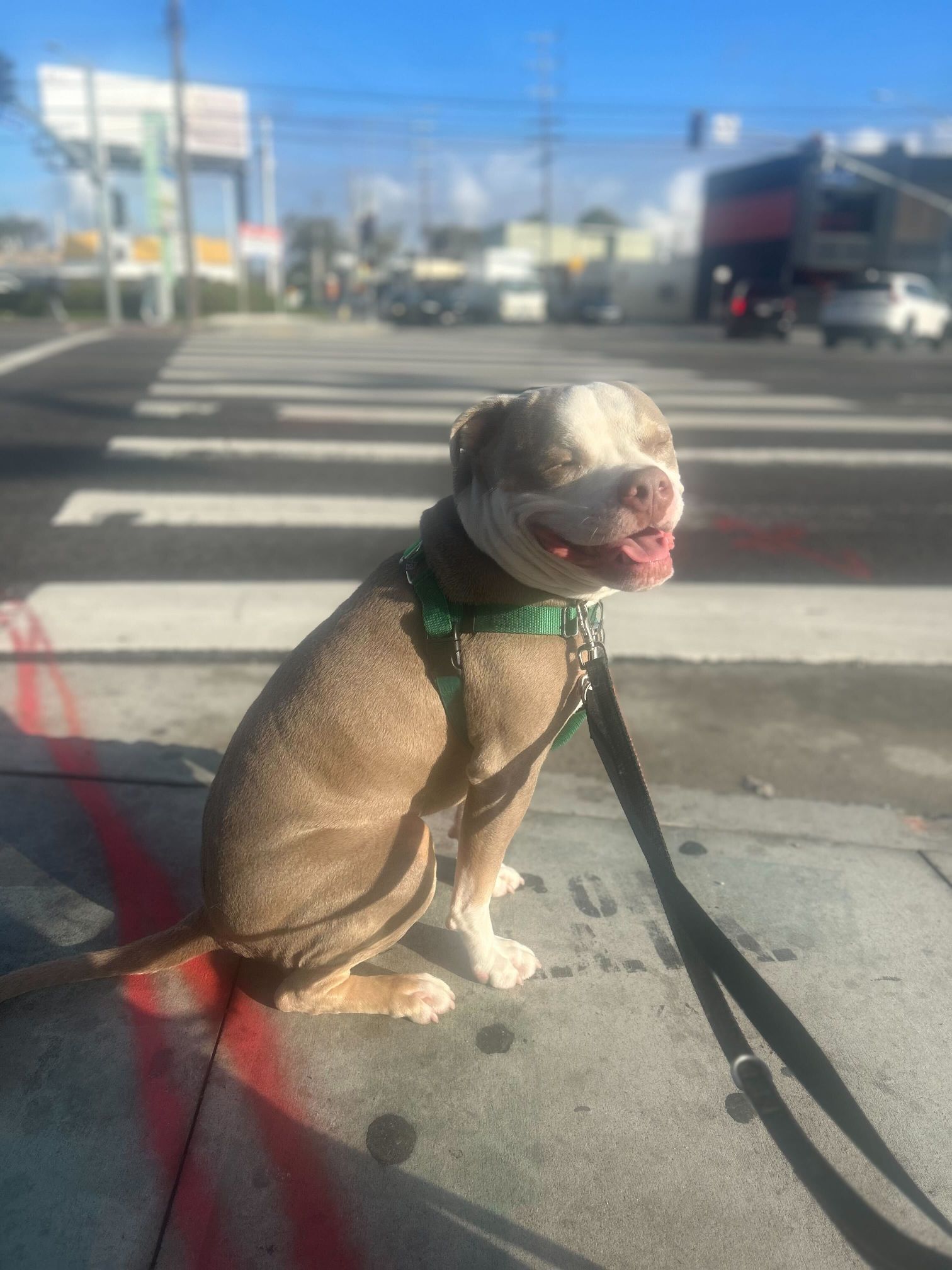
With over 35 years of experience training dogs across the Westside, the most common mistakes our team sees isn’t a lack of love or effort—it’s a lack of consistency and engagement. Owners frequently allow their dog to pull for 90% of the walk as long as the dog isn’t actively dragging them into traffic, and then they suddenly try to correct the dog for the last 10% when a major distraction appears.
Here is the candid truth: Inconsistency is the ultimate enemy of dog training. If you allow your dog to move forward while there is tension on the line, you are actively teaching them that pulling is the engine that powers the walk. Dogs learn from continuous environmental patterns, not occasional interventions.
If your dog doesn’t look at you and check in ever, that is a sign that the rest of the world is more rewarding to your dog. You need to work hard to get engagement on a walk, so you just might need to be more interesting than a squirrel, and that’s hard!
Case Study: Max’s Journey from Freight Train to Loose-Leash Pro
To show you what true consistency can achieve, look at a dog that graduated from our West LA facility just last month.
🐾 Real Client Spotlight: Max the Labrador Retriever
Max is a lovable, 75-pound Labrador Retriever from Santa Monica. His owner came to us completely exhausted because Max had pulled her off her feet. On their walks near the beach, Max would forge ahead with his head down like a freight train. She had tried everything she knew, but Max just pulled his merry way along.
When Max joined our intensive Educational Daycare program, we didn’t use force. We simply changed the rules of the game. We taught Max that a tight leash meant all forward momentum completely vanished, while a loose leash unlocked rewards and exploration. Within four weeks, Max was walking with a relaxed, J-shaped loop in his leash, and his owner was able to enjoy their walks again.
Why Dogs Pull in the First Place
Your dog isn’t trying to dominate you, and they aren’t just being stubborn. They pull for two basic reasons:
- Pulling Works: It is a highly effective, self-reinforcing system. Every time your dog tenses up, drags you forward three feet, and successfully sniffs that fire hydrant or greets a stranger, their brain registers a win.
- The Opposition Reflex: Biologically, dogs possess an involuntary opposition reflex (thigmotaxis). When you pull backward on a dog’s leash, their natural physical response is to lean their weight forward and push right back against that pressure.
What Absolutely Doesn’t Work (and Why)
Before looking at solutions, let’s clear away the outdated advice that frequently backfires on busy LA streets:
- Yanking and Popping the Leash: Jerking back on the leash triggers that natural opposition reflex, turning your walk into an endless tug-of-war match that a large dog will almost always win.
- Aversive Collars: Choke chains and prong collars suppress pulling temporarily through localized pain and discomfort. However, they fail to teach the dog the actual skill of walking politely. Worse, for overstimulated dogs in dog dense areas like Abbot Kinney or Playa Vista, these collars can link the physical pain to the sight of other dogs, causing severe leash reactivity.
- Retractable Leashes: These are a nightmare for leash manners. Because a retractable leash requires continuous tension to extend, it actively teaches your dog that a tight leash is exactly what allows them to explore. They also do not teach your dog where you DO want them to be.
🐾 Ready to stop the tug-of-war? You don’t have to navigate this alone. Whether you’re in Culver City, Beverly Hills, or Venice, we can help you build a flawless walk. Book a free 15-minute Discovery Call with our West LA team right now.
The Right Gear: Tools That Give You Leverage
Disclaimer: As an Amazon Associate, we earn a small commission from qualifying purchases made through the affiliate links below at no extra cost to you.
While gear alone won’t train your dog, switching to ergonomic, force-free tools can give you immediate mechanical leverage while you work on behavior modification.
- The Front-Clip Harness: Traditional back-clip harnesses wrap around a dog’s chest muscles, essentially acting like a sled-pulling harness. Instead, we highly recommend a front-clip design like the 2 Hounds Design Freedom No-Pull Harness. When your dog attempts to forge ahead, the chest-clip gently steers their momentum back toward you.
- A Standard 6-Foot Fixed Leash: Ditch the nylon ropes that cut into your hands. A durable, weatherproof Biothane training leash gives you an incredible, non-slip grip regardless of weather or ocean air.
- High-Value Training Treats: Sidewalk distractions require high-value payment. Keep some freeze-dried liver or roasted chicken easily accessible in a dedicated magnetic treat pouch so your training timing is split-second accurate.
The Loose-Leash Blueprint: What Actually Works
A polite walk is a highly sophisticated, trained behavior. To build it reliably around real-world distractions, follow our core positive reinforcement dog training methods framework:
1. Master the Art of “Becoming a Tree”
The moment the leash goes completely tight, you stop dead in your tracks. Do not yank back; simply anchor your arm to your core and wait. The walk does not resume until your dog backs up, steps to the side, or turns around to put slack back into the line. This teaches them that tension is a red light, and slack is a green light.
2. Heavily Reward the “Check-In”
Don’t wait for your dog to make a mistake. The second your dog willingly looks back at your face or drifts into your immediate perimeter, mark that choice with a cheerful “Yes!” and feed a high-value treat right at your hip. You are teaching them that staying near you is far more lucrative than forging ahead.
3. Step Down the Distraction Ladder
Do not expect your dog to focus on an incredibly busy street like Abbot Kinney if they can’t even walk nicely in your quiet hallway or backyard. Build the habit in low-distraction environments first, then slowly move to a quiet side street in a residential area, then a local park, and finally a busy urban environment.
🚶♂️ Want guided, hands-on practice? If you want to fast-track your progress with real-time coaching, join our next Walking Wonders loose-leash workshop or refine your overall obedience boundaries in our Life Skills and Manners class.
When to Call a Professional
If your dog is incredibly strong and their pulling feels physically dangerous, or if the pulling is accompanied by aggressive lunging, barking, or hyper-arousal at the sight of triggers, this goes beyond standard leash etiquette. Leash reactivity requires a structured, delicate approach, and trying to handle it via force or miscalculated corrections can make the underlying anxiety much worse.
At I Said Sit!, we have been helping local pet parents build reliable, real-world obedience since 1988. Whether you want to join us for our immersive educational dog daycare program where our handlers install the daily repetitions for you, or prefer customized private dog training lessons to build your own handling skills, we have a pathway that fits your lifestyle perfectly.
Let’s make your daily walks enjoyable again.
👉 Book your free 15-minute Discovery Call today or give our West LA team a call at (310) 558-9037 to get started!