Disclaimer: As an Amazon Associate, we earn a small commission from qualifying purchases made through the affiliate links in this post at no extra cost to you.
 Every single week at I Said Sit!, someone calls our West LA facility doors and says some variation of the exact same phrase: “I just want a well-trained dog.”
Ask five different dog owners what that actually means, however, and you will get five vastly different answers:
-
For one person, it’s a dog that knows fancy party tricks like “shake” or “roll over.”
-
For another, it’s a dog that doesn’t jump on guests when they walk through the door.
-
For traditional old-school handlers, it means absolute “robot obedience” at all costs.
In honor of National Dog Week, we wanted to answer this question honestly. Drawing from over 30 years of training dogs across Culver City, Santa Monica, Venice, and Mar Vista, here is what actually defines a truly well-trained dog.
🎭 It’s Not About Tricks (Performance vs. Capability)
A dog that can sit, shake, and roll over on command inside a quiet living room can still turn into an uncontrollable nightmare on a leash, a stress case at the vet, or a liability around other dogs.
Tricks are simply performance. Real behavior modification is about something far deeper: teaching a dog how to think clearly, regulate their nervous system, and make good choices even when the environment gets exciting, noisy, or chaotic.
🏛️ The Three Pillars of a Well-Trained Dog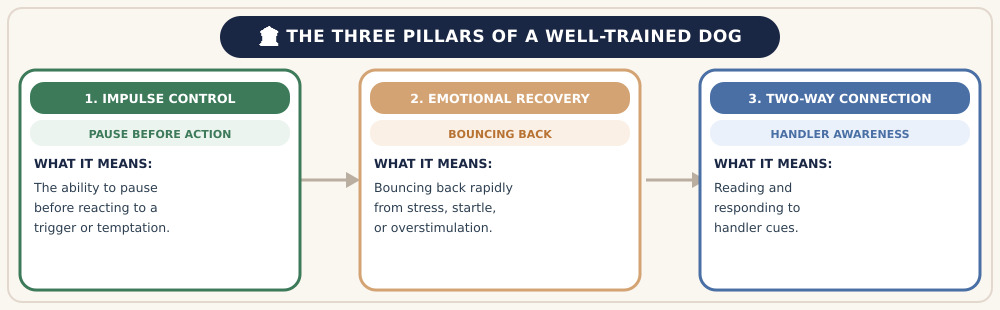
Instead of measuring success by how many cues a dog knows, our positive reinforcement methods measure success by three core neurological capabilities:
1. Impulse Control
Can your dog see a darting squirrel, a dropped french fry on an outdoor patio, or another dog walking down the sidewalk and still check in with you? That micro-pause—the ability to think before acting—is the foundational bedrock of all real-world training.
2. Emotional Stability & Recovery
A well-trained dog isn’t necessarily fearless, but they recover quickly when startled. Whether it’s a loud delivery truck on Washington Boulevard or a sudden bark from behind a fence, a stable dog startles, assesses the situation, and returns to a calm baseline rather than remaining wound up for the rest of the walk.
3. Reliable Two-Way Communication
Training isn’t about a dog complying out of fear or intimidation. It’s about a mutual partnership—your dog understands your cues, and you know how to read your dog’s subtle body language back.
⚖️ “Robot” Obedience vs. Real-World Capability
To understand why traditional, forced obedience fails in modern life, consider how a dog navigates everyday Southern California scenarios: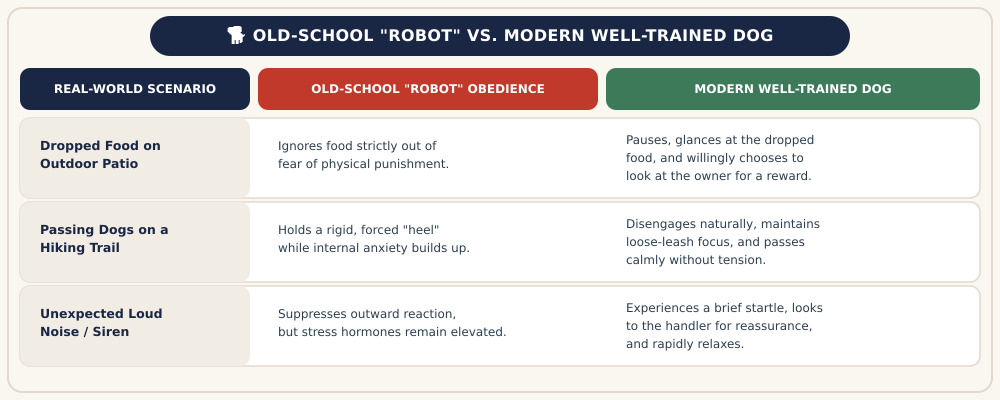
🎒 Gear to Support Real-World Calmness
Building emotional stability at home and out in public requires management tools that reward clear choices:
-
Portable Travel Mat: Teaching a reliable “settle” cue at outdoor restaurants is easy when you bring a comfortable, roll-up Travel Dog Mat.
-
Hands-Free Training Leash: Keep your body language relaxed while hiking local trails like Griffith Park using a durable Hands-Free Leash.
-
Rapid-Delivery Reward Pouch: Reward those split-second decisions to disengage from distractions with the magnetic Dog Treat Pouch.
🌴 What a Well-Trained LA Dog Looks Like Day-to-Day
When you focus on confidence and connection rather than rigid performance, your dog can comfortably navigate city life:
-
Walking past reactive dogs on busy West LA sidewalks without lunging or barking.
-
Settling calmly under your table at an outdoor cafe in Santa Monica.
-
Coming back reliably when called, even around park distractions.
-
Greeting guests at your front door politely without jumping or overarousal.
-
Resting comfortably at home without separation anxiety when left alone.
None of this requires your dog to act like a machine. A well-trained dog still has personality, playfulness, and quirks—training simply gives them the emotional tools to navigate our human world with confidence.
🗓️ Ready to Build a Calmer, More Confident Companion?
If your dog isn’t there yet, don’t worry—emotional regulation and impulse control can be built at almost any age.
Whether your pup needs early social foundations in our educational daycare, structured distraction work in our group training classes, or an immersive reset through our Boarding School program, our certified handlers are here to guide you.
Let’s talk about what’s happening with your dog and design a plan that fits your family’s lifestyle.
👉 Book your free 15-minute Discovery Call today or give our West LA team a call directly at 📞 (310) 558-9037!