Disclaimer: As an Amazon Associate, we earn a small commission from qualifying purchases made through the affiliate links in this post at no extra cost to you.
Your dog is nine years old, gray is creeping across their muzzle, and somewhere along the way, you convinced yourself that the training window had permanently slammed shut.
Maybe you just adopted a sweet senior from the West LA Animal Shelter and quickly discovered that walking politely on a leash is a complete mystery to them. Maybe your lifelong best friend has spent the last eight years dragging you toward every squirrel in Griffith Park or jumping all over guests at your front door.
Whatever brought you here, you are probably asking the same quiet question every senior dog owner asks me: Is training an older dog even possible, or am I just setting us both up for frustration?
Not only is it possible—in my 16 years on the training floor at I Said Sit!, I’ve found that training a mature dog is often faster, calmer, and infinitely more rewarding than starting with an unruly puppy.
👵 Is It Too Late for Training an Older Dog?
The tired old adage “You can’t teach an old dog new tricks” is easily one of the most damaging myths in the entire pet industry.
Canine brains retain neuroplasticity throughout their entire lives. Dogs don’t suddenly lose their capacity to learn simply because they’ve had a few birthdays. What changes as a dog ages is their physical stamina, their sensory acuity, and the depth of their rehearsed habits—not their intelligence.
When an owner walks into our facility and tells me, “Elisha, I think he’s just set in his ways,” my response is always the same:
💬 My Take on the “Set in His Ways” Myth
Your dog isn’t stubborn, spiteful, or untrainable. If an eight-year-old dog jumps on guests, they haven’t failed—they’ve just had eight straight years of daily rehearsal proving that jumping earns human eye contact and attention! The second we make a calmer choice pay better, the behavior shifts. The dogs who struggle the most aren’t the oldest; they’re the ones whose humans decided it was too late to try.
🎓 Why Older Dogs Are Often Fantastic Students
While puppies get all the attention on social media, mature dogs bring distinct superpowers to a training session:
- Longer Attention Spans: A 7-year-old dog can focus on a handler for 5 to 10 solid minutes without the wild bouncing, nipping, and frantic distraction typical of an 8-week-old puppy.
- Natural Impulse Control: Mature dogs have developed adult nervous systems. They are far less prone to random zoomies, destructive chewing, or frantic mouthiness mid-lesson.
- Strong Food & Social Motivation: Older dogs know how the world works. They appreciate clear communication, love soft treats, and relish having a “job” that engages their mind.
Whether you’ve shared a couch together for a decade or welcomed an older rescue into your home last weekend, gentle training is the fastest way to deepen mutual trust.
🩺 Step 1: Start With a Comprehensive Vet Visit
Before you teach a single cue, schedule an appointment with your veterinarian. This is non-negotiable when training an older dog.
In senior canines, what looks like behavioral defiance is very often undiagnosed physical discomfort:
- A dog who suddenly hesitates or ignores a “Sit” cue isn’t being “stubborn”—their arthritic hips or stiff lower back may make tucking into a sit physically painful.
- A dog who stops responding to their recall cue may be experiencing gradual hearing loss.
- A dog who becomes grumbly or startles when approached on their bed may be dealing with cataracts or diminished peripheral vision.
Have your vet evaluate joint mobility, vision, and hearing. Once you know their physical baselines, you can tailor your training to support their body.
🛠️ How to Start Training an Older Dog
At I Said Sit!, our entire curriculum is grounded in humane, positive reinforcement training methods. The underlying science of learning is identical whether a dog is 12 weeks or 12 years old: reward what you want to see, manage the environment to prevent mistakes, and make every repetition fun.
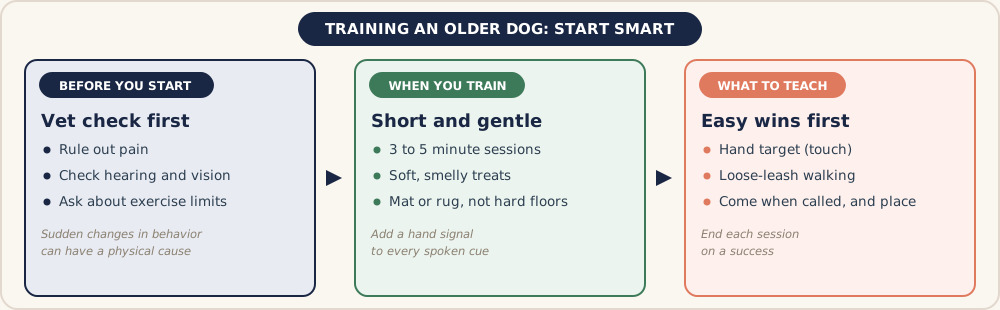
1. Keep Sessions Micro-Sized (3 to 5 Minutes)
Older brains and bodies tire out much faster than adolescent dogs. Two short 3-minute training games a day produce far better results than a single grueling 30-minute drill. Always stop while your dog is winning and begging for more.
2. Prioritize Traction and Joint Comfort
Never train a senior dog on slippery hardwood, laminate, or tile floors. Slipping creates immediate fear and can cause painful groin pulls or disc flare-ups. Set up your training space on an area rug, a runner, or an inexpensive yoga mat. Furthermore, stop obsessing over the traditional “Sit.” Teach a comfortable standing “Wait” or a flat “Place” settle instead.
3. Upgrade to Soft, Ultra-Smelly Treats
As dogs age, their olfactory sensitivity declines. Dry biscuits won’t cut it. Use warm hot dog slivers, real roasted chicken breast, or soft liver treats that smell irresistible and require zero chewing effort for older teeth.
4. Always Pair Spoken Cues with Visual Hand Signals
Hearing loss is extraordinarily common in older dogs. If you only train with verbal words, your training will dissolve the moment their ears decline. Pair every cue with a distinct visual hand gesture. If hearing is already compromised, visual cues and gentle leash vibrations become your primary language.
🎯 5 Core Skills Worth Teaching a Senior Dog
You don’t need a 20-trick repertoire to dramatically improve your senior dog’s quality of life. Focus on these practical foundations:
- Hand Targeting (“Touch”): Teaching your dog to bump their wet nose against your flat palm is the ultimate low-impact exercise. It gets stiff joints moving, sharpens focus, and acts as an effortless steering wheel for positioning. (Check out our November 2 Instagram Reel where we demonstrate this exact game with a mature dog!)
- Polite Loose-Leash Walking: Walking calmly at your side eliminates neck strain and protects aging spinal columns from sudden jolts.
- Emergency Recall: A reliable recall cue keeps your dog safe if they wander or if local wildlife appears on a path.
- The “Place” Cue: Sending your dog to a cushioned orthopedic bed gives them a designated quiet zone when guests arrive, eliminating front door chaos.
- Cooperative Care & Handling: Teaching your dog to willingly offer their paw for nail trims or relax during veterinary palpations removes fear from medical care as they age.
🌴 Local LA Tips for Senior Dog Owners
Navigating Los Angeles with an older dog is all about timing, surface selection, and avoiding crowd chaos:
- My Favorite Quiet Senior Walking Spot: Skip the hectic weekend crowds at Runyon Canyon or the Santa Monica Promenade. Instead, head to Holmby Park in Westwood (just south of Sunset). It features flat, beautifully maintained grass lawns, wide shaded walking paths, and a calm, quiet atmosphere where senior dogs can sniff leisurely without getting mobbed by hyperactive off-leash dogs. Another local gem is the shaded dirt trail perimeter around Cheviot Hills Recreation Center on weekday mornings before 8:30 AM.
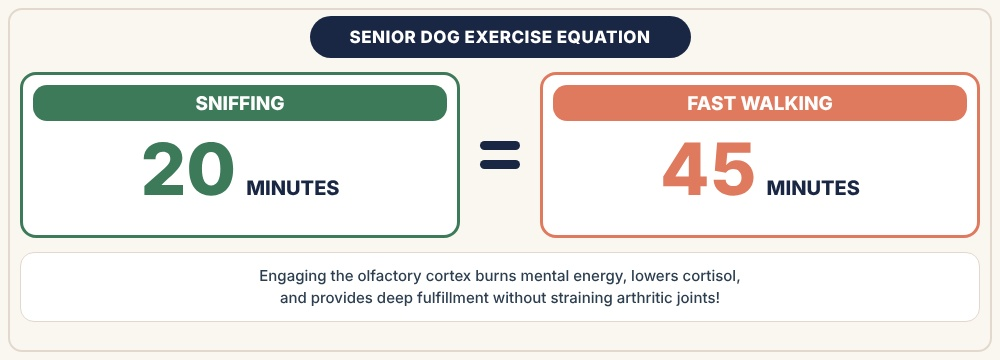
- Beat the Westside Heat: Older dogs cannot regulate their body temperature as efficiently as young dogs. During hot Santa Ana wind stretches, walk strictly before 7:30 AM or after dusk, stick to grass or dirt, and let sniffing take the place of physical distance.
🛍️ Essential Gear for Training an Older Dog
Supporting your senior dog’s body makes learning infinitely easier and pain-free:
- Soft, Highly Palatable Rewards: Keep training easy on older teeth with bite-sized Zuke’s Mini Naturals Training Treats.
- Supportive Assistance Harness: Protect fragile necks and assist dogs with hip weakness using the Ruffwear Flagline Multi-Use Dog Harness with Lift Handle.
- Cushioned Non-Slip Training Mat: Give stiff joints non-slip stability during home sessions with an extra-thick BalanceFrom High Density Non-Slip Yoga Mat .
🗓️ When to Seek Professional Guidance
You should consult a certified professional trainer if:
- Your older dog is showing sudden fear, growling, or resource guarding that seems new.
- You recently adopted a mature dog and need help integrating them smoothly into your household.
- You aren’t sure whether a specific behavior is rooted in cognitive decline (canine cognitive dysfunction), sensory loss, or training gaps.
At I Said Sit!, we have been serving families across our West LA service area—including Culver City, Santa Monica, Venice, Mar Vista, Palms, and West Adams—since 1988.
Our customized private dog training lessons take place right in the comfort of your living room, designed entirely around your dog’s physical stamina, health, and routine. For calm seniors who enjoy canine companionship, our structured group dog training classes and educational dog daycare offer enriching, controlled environments tailored to your dog’s pace.
It is never too late to start. Your older dog has plenty of love to give, plenty of brainpower to flex, and will relish every moment you spend learning together.
👉 Book your free 15-minute Discovery Call today or give our West LA team a call directly at 📞 (310) 558-9037 to design a gentle, rewarding plan for your senior companion!