Disclaimer: As an Amazon Associate, we earn a small commission from qualifying purchases made through the affiliate links in this post at no extra cost to you.
You bring home a dog because you want a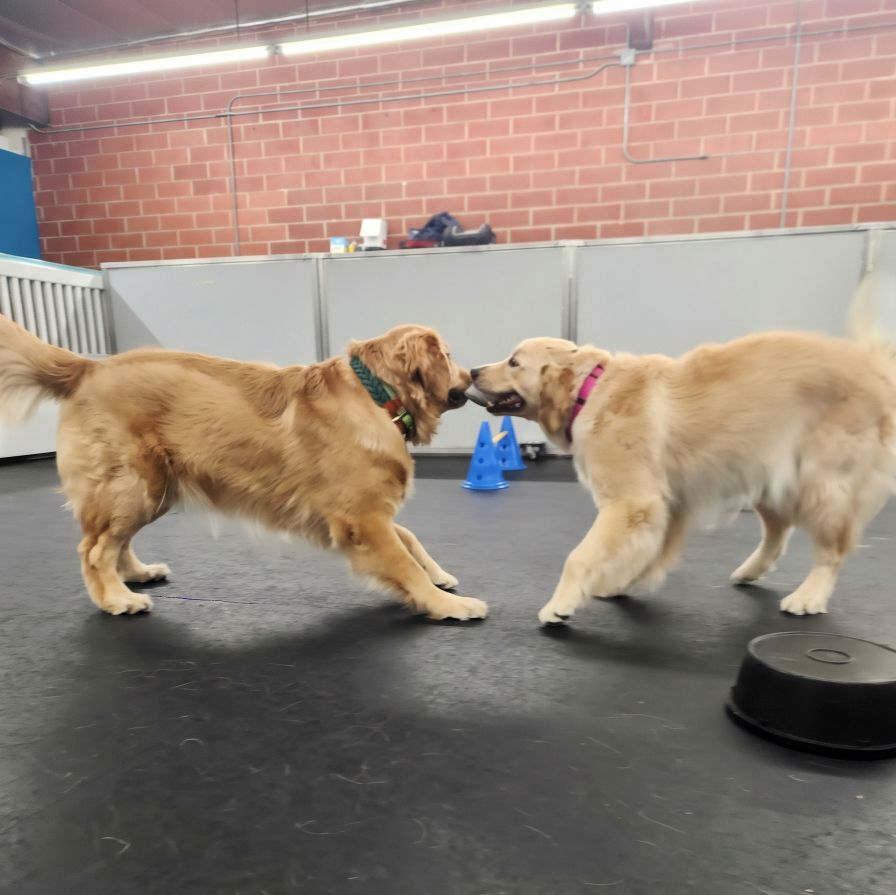 companion to share your life with—and naturally, you want them to be social, confident, and friendly around other dogs.
So you weigh your options: do you clip on the leash and head to the local off-leash dog park every weekend, or do you sign up for a more controlled environment?
If you are comparing a dog park vs structured playgroups, you are asking the absolute right question. In the training world, “socialization” does not mean forcing your dog to mingle in an unregulated free-for-all. True socialization means building positive, safe experiences with the right dogs, in the right setting, at the right developmental pace.
Having spent 16 years on the training floor here at I Said Sit! (serving West LA, Culver City, Santa Monica, Venice, and Mar Vista since 1988), I am going to give you my completely honest, unfiltered trainer’s perspective on both options. 🐕
🏞️ What a Dog Park Really Offers (The Unfiltered LA Reality)
Los Angeles has no shortage of off-leash dog parks, from Barrington Dog Park in West LA and Laurel Canyon in Studio City to neighborhood runs across the Westside. They are free, convenient, and give dogs plenty of room to stretch their legs.
For a dog that is exceptionally well-socialized, highly resilient, physically fit, and possesses an emergency recall, a quiet dog park visit can be a fun outing.
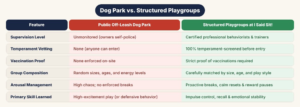
However, a public dog park is fundamentally an uncontrolled environment.
When you walk through those double gates, you have zero control over:
- Who else is inside: You don’t know the behavioral history, vaccination status, or stress levels of the other dogs.
- Owner attentiveness: Many park visitors treat the dog park as a break for themselves, scrolling on their phones while their dog over-arouses others or exhibits pushy, rude behaviors.
- Pack mentality: High arousal spreads like wildfire. A single over-excited dog or a bottleneck at the entry gate can turn normal play into an intense, scary scuffle in milliseconds.
My honest take? I rarely recommend public dog parks for most dogs and never for puppies, adolescent dogs, or timid rescues. On our training floor, at least half of the leash reactivity cases we see in young adult dogs can be traced directly back to a single scary or overwhelming incident at a public dog park.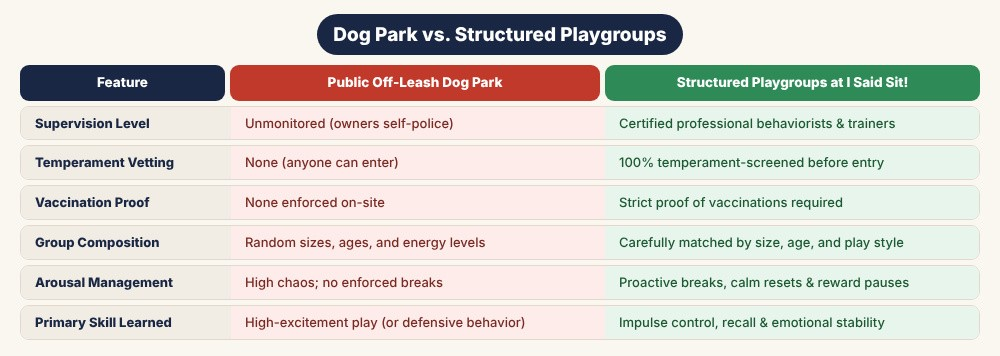 🏛️ What Structured Playgroups Offer
A structured playgroup is the complete opposite of an uncontrolled park. It is a carefully curated educational environment where every variable is managed by professionals.
At I Said Sit!, our playgroups are engineered to build real-world confidence:
- Rigorous Matchmaking: Dogs aren’t just thrown together. They are paired strictly by size, age, energy level, and play style (e.g., gentle wrestlers play together, while high-speed chasers get their own group).
- Low Staff-to-Dog Ratios: Experienced handlers watch body language—tail tucks, lip licks, hard stares—and step in gracefully before arousal turns into tension.
- Enforced Rest Rotations: Real socialization requires learning how to settle around other dogs, not just playing until exhaustion. We have a structured day and rest breaks are woven into the experience.
- Manners Under Distraction: Good behavior is continuously rewarded. Dogs practice recall out of play, polite gate entry, and impulse control.
This structured framework is the core foundation of our educational dog daycare program. Your dog doesn’t just run frantic laps—they learn how to communicate politely, respect boundaries, and come home emotionally fulfilled and calm.
🎯 Which Option Is Right for Your Dog?
A Public Dog Park Might Work If:
- Your dog is an adult, confident, physically stable, and completely neutral around other dogs.
- They have a rock-solid, automatic recall cue even when playing.
- They take corrections from other dogs politely and walk away from high-arousal groups.
- You visit during non-peak, quiet hours and are prepared to leave the instant an attentive or pushy dog enters.
Structured Playgroups Are Necessary If:
- You have a puppy or adolescent dog who is still learning foundational social manners.
- Your dog is shy, sensitive, easily overwhelmed, or prone to over-arousal.
- Your dog has experienced a previous scary encounter, fight, or attack.
- You want your dog’s social time to reinforce good training rather than dismantling it.
- You want complete peace of mind while at work, knowing trained staff are managing every interaction.
🎒 Gear to Support Safe Socialization & Management
Whether practicing focus near a park or working through social skills, having the right management gear is essential:
- 🦮 Long Training Line: Practice distance recalls safely near open spaces using a Biothane Waterproof Long Line.
- 🎯 Rapid-Access Reward Pouch: Deliver split-second rewards when your dog disengages from another pup with the magnetic Dog Treat Pouch.
- 🧘 Portable Settleme Mat: Teach your dog to relax in high-distraction environments using the Waterproof Travel Dog Mat.
🎓 Where Group Classes & Private Training Fit In
Socialization isn’t just about playing—it is primarily about neutrality. A truly well-socialized dog can walk past another dog on a sidewalk in Culver City or Venice without reacting, lunging, or whining.
- Building Focus Around Distractions: In our group dog training classes, dogs do not play on-leash. Instead, they learn to focus entirely on their handlers while other dogs are nearby. This builds the impulse control required for safe public outings.
- Addressing Fear or Reactivity: If your dog is already barking, lunging, or hiding around other dogs, throwing them into a playgroup or dog park will only worsen their fear. Our private dog training lessons provide a safe, one-on-one space to rebuild their emotional baseline using humane positive reinforcement methods.
🚩 Warning Signs Your Dog Needs a Break From the Park
If you notice any of these behavioral warning signs during or after a park visit, your dog is telling you they are overwhelmed:
- Hiding & Seeking Anchor: Hiding behind your legs, sitting under park benches, or constantly checking in to be picked up.
- Developing Reactivity: Starting to bark, lunge, high arousal at the sight of other dogs on walks.
- Stress Body Language: Tucked tail, pinned ears, stiff posture, lip-licking, or intense “hard staring.”
- Bullying or Being Bullied: Repeatedly mounting other dogs, pinning pups, or refusing to respect another dog’s warning growl.
- Selective Hearing: Completely ignoring your recall cue when normally obedient at home.
🗓️ Ready to Give Your Dog a Safer Social Outlet?
Socialization should build your dog up, not stress them out. By prioritizing quality interactions over chaotic quantity, you set your pup up for a lifetime of confidence and emotional balance.
At I Said Sit!, we have been helping Los Angeles pet parents raise polite, confident, and well-socialized companions since 1988.
Let’s discuss your dog’s unique personality and build a socialization plan tailored to their needs.
👉 Book your free 15-minute Discovery Call today or call our West LA facility directly at 📞 (310) 558-9037 to get started!