Disclaimer: As an Amazon Associate, we earn a small commission from qualifying purchases made through the affiliate links in this post at no extra cost to you.
You walk past your dog while they are curled up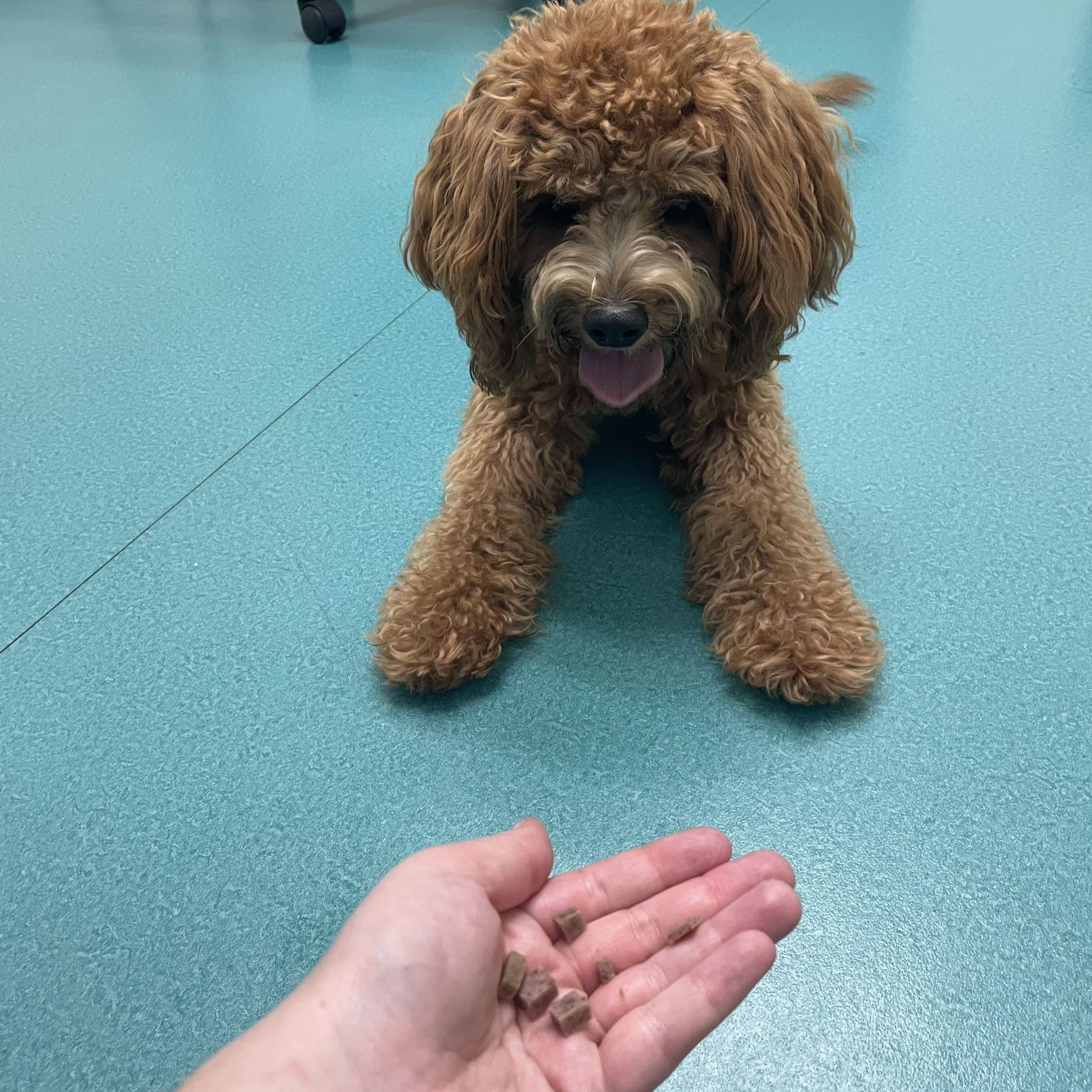 enjoying a chew bone on the living room rug. Suddenly, they freeze. Their spine goes rigid, their head lowers over the bone, their upper lip twitches upward, and you hear a low, rumbling growl you have never heard come out of your sweet pet before.
Or maybe you reached down to grab a dirty sock your dog snagged from the laundry basket, and they snapped at your fingers.
It is startling, deeply upsetting, and often leaves owners feeling heartbroken or betrayed. Your immediate panic says: “Fix this right now before someone gets bitten!”
Take a deep breath. In my 16 years coaching local families on our training floor at I Said Sit! (serving our West LA service area, including Culver City, Santa Monica, Venice, and Mar Vista since 1988), resource guarding is one of the most common behavioral challenges we evaluate.
Here is what resource guarding actually is, the dangerous mistakes that make it worse, and how humane, reward-based dog resource guarding training resolves the issue for good.
🥩 What Is Resource Guarding?
Resource guarding occurs when a dog feels compelled to protect an item they perceive as valuable: food bowls, marrow bones, plush toys, stolen laundry, a cozy spot on the couch, or even a specific human handler.
From an evolutionary standpoint, guarding is completely natural canine behavior. In the wild, an animal that casually gave away their meal or sleeping den did not survive. While living in a modern living room means your dog will never starve, their primal brain doesn’t always know that.
Guarding does not mean your dog is “broken,” spiteful, or “mean.” It simply means your dog experiences underlying anxiety that an approaching human will take their prized possession away.
🚩 Early Warning Signs (The Escalation Ladder)
Dogs rarely bite out of nowhere. Guarding almost always follows a predictable escalation:
- The Freeze: Body suddenly goes stiff and motionless.
- Hovering & Rapid Ingestion: Leaning over the item or eating significantly faster as you approach.
- Hard Staring / Whale Eye: Glancing up with a locked gaze, showing the whites of their eyes without moving their head.
- Muzzle Lift & Low Growl: Showing teeth and vocalizing a clear warning.
- Air Snap or Bite: Snapping toward your hand or making physical contact when earlier warnings were ignored.
🚫 Busting the “Dominance” Myth (And Why You Should Never Punish a Growl)
For decades, old-school television trainers spread the destructive myth that resource guarding is about “dominance”—that your dog is trying to be the “alpha pack leader” and that you must “show them who is boss” by forcefully prying open their jaws, sticking your hands in their food bowl, or pinning them to the floor in an “alpha roll.”
This advice is not just outdated; it is dangerous.
Attempting to physically intimidate a guarding dog confirms their deepest, most primal fear: human hands approaching my stuff means violence and loss. When you fight your dog for an item, you validate the conflict, immediately escalating mild guarding into defensive biting.
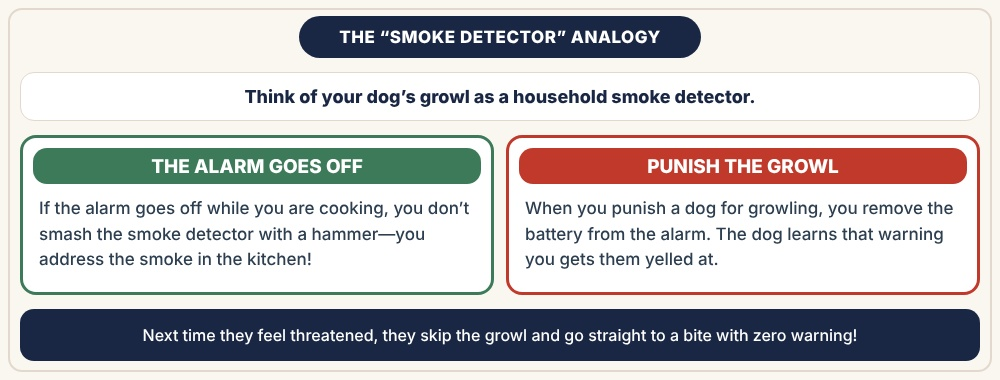
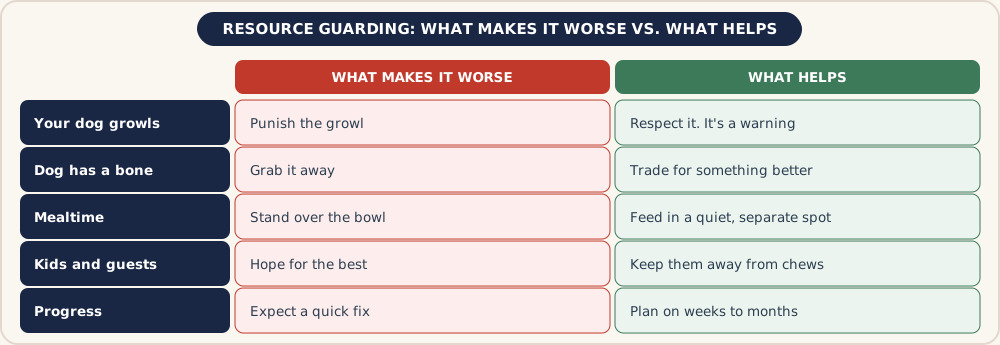
Never punish the growl. Respect the warning, give your dog space immediately, and address the underlying emotional worry using positive reinforcement methods.
🛑 What Doesn’t Work (And Why)
- ❌ Prying Jaws Open by Force: Wrestling a stolen tissue or chew out of your dog’s mouth teaches them to swallow items whole next time or bite faster to defend it.
- ❌ Standing Over the Bowl to “Test” Them: Sticking your hands into their kibble or arbitrarily taking their bowl away mid-meal creates frantic eating anxiety in a dog that was previously relaxed.
- ❌ Yelling or Scolding: Anger increases cortisol, heightening tension in an already stressed nervous system.
🛠️ The Reward-Based Training Protocol: How to Fix It
To fix resource guarding safely, we use desensitization and counter-conditioning. We want your dog’s emotional response to shift from “Oh no, they are going to steal my bone!” to “Yay! A human is approaching, which means something even better is about to rain from the sky!”
1. Management First (Stop the Rehearsal)
Before training, remove the triggers:
- Private Dining: Feed your dog in a quiet room, inside an open crate, or behind a pressure-mounted baby gate. No other pets or humans are allowed to walk past while they eat.
- Remove High-Conflict Items: Store raw beef bones, bully sticks, or pig ears in a secure cabinet for now. Stick to regular meals and rubber KONG toys.
2. The Distance “Treat-Toss” Exercise
- While your dog is eating low-value food or chewing a valued toy, walk past at a safe distance (typically 8 to 12 feet away—well outside their reaction zone).
- Without pausing or making intense direct eye contact, toss a piece of warm roasted chicken or string cheese directly toward their paws, then keep walking away.
- The Safety Rule: If your dog stiffens, stops eating, or gives a hard stare, you are too close. Immediately increase your distance by five feet.
- Repeat this over several weeks. Your dog will begin lifting their head with loose, happy body language whenever you approach, anticipating the chicken!
3. Always “Trade Up” (Mastering the Drop It)
Never steal an item from your dog. Always offer a trade:
- Show your dog a piece of high-value meat (“Look what I have!”).
- Toss the treat a few feet away from them.
- While your dog steps away to eat the treat, calmly pick up the guarded object.
- The Magic Step: If the item isn’t dangerous (like a legal dog toy), hand it right back! When a dog learns that dropping an object often results in getting both a treat and their toy back, they stop guarding.
🏫 How We Handle Resource Guarding at I Said Sit!
Pet parents frequently ask us: “Can a dog with guarding tendencies still attend daycare or boarding?”
At our West LA facility, safety and prevention are built into our physical layout:
- 🚫 No High-Value Chews in Playgroups: In our communal play yards, we never introduce chew bones, food bowls, or marrow chews. Group play revolves strictly around balanced social play, movement, and human engagement.
- 🚪 Private Dining Suites: During boarding or daycare meal breaks, every dog eats in their own individual, enclosed private suite with zero visual or physical competition from neighbor dogs.
- 🧑🏫 Certified Body-Language Monitors: Our certified staff monitors micro-body language—intervening gently with redirection before tension or posturing can ever occur.
This structured environment is the cornerstone of our Dog Boarding School Program, where dogs learn consistent impulse control and polite manners under professional supervision.
🛍️ Essential Tools for Resource Guarding Management
Equipping your home with the right tools eliminates daily friction and keeps everyone safe:
- 🚧 Walk-Through Safety Gate: Give your dog a secure, private dining room with the Extra Tall Walk-Through Pet Gate.
- 🧩 Slow Feeder Bowl: Turn fast, anxious gulpers into calm foragers with the Outward Hound Fun Feeder Slo Bowl.
- 🥩 Ultra-Smelly High-Value Rewards: Keep trades irresistible using Stewart Freeze-Dried Beef Liver Dog Treats.
- 🎯 Magnetic Rapid-Access Treat Pouch: Always keep high-value trade currency right on your hip with the PetSafe Sport Dog Treat Pouch.
⏱️ How Long Does It Take to Fix Resource Guarding?
We believe in being 100% candid with dog owners: reversing emotional guarding habits takes steady, patient consistency.
- Mild Guarding (stiffening or low growls over bones): With strict environmental management and daily treat-tossing, most families see dramatic relaxation within 4 to 8 weeks.
- Ingrained Guarding (dogs with a history of snapping or biting over multiple items): Requires a longer, multi-month desensitization program guided by an experienced behavior professional.
Progress is measured in small emotional wins: seeing your dog wag their tail when you walk past their bowl instead of freezing is a massive victory!
🗓️ When to Call in a Professional Trainer
You should seek professional, hands-on guidance immediately if:
- Your dog has snapped at, lunged at, or bitten any person or pet.
- Your dog guards human family members, hallways, doorways, or furniture.
- There are young children, toddlers, or elderly family members in the home.
- The guarding behavior began suddenly in an adult dog (which warrants an immediate veterinary exam to rule out dental pain or spinal arthritis).
At I Said Sit!, we have been helping Los Angeles pet parents solve complex behavioral challenges like resource guarding since 1988.
Our customized private dog training lessons take place in your own living room, allowing us to evaluate your home layout, observe your dog’s triggers safely, and build a stress-free management plan. For dogs needing impulse control and focus around people, our group dog training classes reinforce reliable manners.
Resource guarding is scary, but you do not have to live in fear in your own home. With management, patience, and positive reinforcement, your dog can learn that human hands bring safety, not conflict.
👉 Book your free 15-minute Discovery Call today or call our West LA team directly at 📞 (310) 558-9037 to get started on a personalized plan!