Disclaimer: As an Amazon Associate, we earn a small commission from qualifying purchases made through the affiliate links in this post at no extra cost to you.
It is 10:30 on a sunny Saturday morning in Southern California. ☀️
Joggers are darting past, double-wide strollers take up half the sidewalk, electric Bird scooters buzz by at fifteen miles per hour, an Amazon delivery van is idling at the curb with screeching air brakes, and dozens of people are walking toward you. Meanwhile, your dog is either frantically pulling at the end of the leash, completely pancaked onto the pavement in a frozen panic, or trying to climb inside your jacket.
If you have wondered how to approach socializing a dog in Los Angeles without inducing sensory overload, you are definitely not alone.
Los Angeles is one of the most dog-loving cities in the world, but our bustling urban environment can be intensely overwhelming for a canine nervous system. After 16 years coaching local dog parents at I Said Sit!, I can assure you that city socialization does not have to be stressful. It just requires a deliberate, step-by-step strategy.
🧠 What Socialization Actually Means (Hint: It’s Not “Greeting Everyone”)
The most widespread misunderstanding among pet owners is the idea that socialization means your dog must physically greet every human, child, and dog they pass on the street.
In the science of animal behavior, true socialization means building emotional neutrality.
A well-socialized city dog is not an extroverted party animal demanding affection from every passerby. A well-socialized dog is one who can watch a chaotic crowd walk past on Abbot Kinney or Montana Avenue and remain completely calm, relaxed, and engaged with their handler.
🛑 Why Forcing Greetings Backfires
When you pull a hesitant dog toward an unfamiliar stranger or let off-leash dogs rush into their personal space, you teach them that busy places are unpredictable and dangerous. That forced interaction frequently turns into on-leash reactivity, growling, or lunging later on. Calm observation paired with high-value rewards always beats physical interaction.
🎒 Before You Step onto the Sidewalk
Setting your dog up for success starts before you leave your front door:
- Vet Clearance & The Puppy Protocol: For young puppies between 8 and 16 weeks old, the critical developmental socialization window is ticking fast. However, their immune systems are still developing. Check with your vet about local parvo risks, but do not keep your puppy locked in sensory isolation at home. Carry them in your arms, use a front-facing puppy carrier sling, or roll them in a pet stroller so they experience LA street sights and traffic noises without their paws touching potentially contaminated sidewalks.
- Ditch the Retractable Leash: Never use a flexi-lead in urban crowds. A standard 6-foot fixed flat leash paired with an ergonomic Y-harness gives you safe, immediate physical control.
- High-Value “City Currency”: Dry kibble will not compete with LA street distractions. Pack soft, aromatic treats like real roasted chicken breast, string cheese, or freeze-dried beef liver.
- Always Scout an Escape Route: Before stopping near a crowd, know where your nearest quiet side street, driveway, or grassy parkway is located in case your dog needs an immediate retreat.
🗺️ Step 1: Start in the “Distance Zone” (Under Threshold)
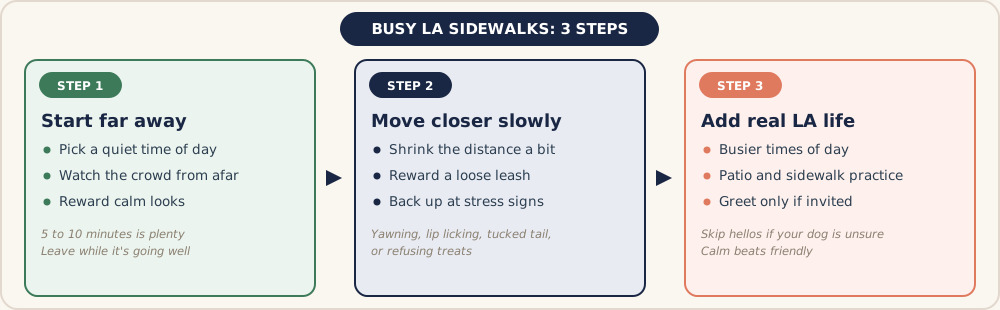
Start your training during low-traffic windows (like 7:30 AM on a weekend) and place yourself 30 to 50 feet away from the main pedestrian flow.
Great starting spots include the quiet residential side streets branching off Culver Boulevard in downtown Culver City, a quiet corner across from the shops on Larchmont Boulevard, or the wide grassy edges of Holmby Park in Westwood.
Stand stationary where your dog can clearly see pedestrians, cyclists, and traffic, but far enough away that they can still easily eat treats and look back at you.
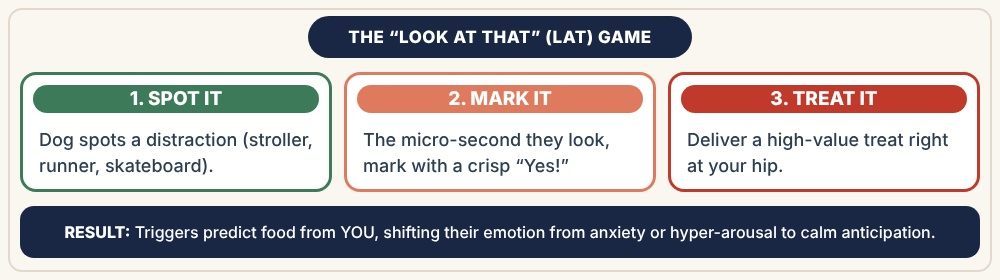
Keep your first street sessions ultra-short—5 to 10 minutes maximum. Always end the game and head home while your dog is calm and winning!
🚶 Step 2: Shrink the Distance & Read Subtle Stress Signals
Over several successful outings, decrease the distance by five to ten feet at a time.
As you get closer to the sidewalk action, pay intense attention to your dog’s early stress signals:
- Yawning when not tired
- Rapid lip-licking
- Tucking the tail tightly between the hind legs
- “Whale eye” (showing the whites of their eyes)
- Sudden stiffening or refusing high-value food they normally love
If your dog stops taking treats, their nervous system has shifted into fight-or-flight. They aren’t being stubborn; they are over threshold. Calmly turn around, create 20 feet of breathing room, and let their heart rate settle. Backing up is never a failure—it proves to your dog that you are their safe protector.
☕ Step 3: Navigating Real LA Life (Patios & Crowded Sidewalks)
Once your dog is comfortable walking near activity, progress to real Los Angeles destinations—like a coffee shop patio in Mar Vista, sidewalk dining along Ocean Park Boulevard, or the open outdoor spaces at the Brentwood Country Mart.
- 🧘 Give Them a Dedicated Job (The “Mat Settle”): Bring a roll-up travel mat and tuck it securely underneath your chair. A designated mat gives your dog a physical boundary and a safe sanctuary where no feet or strollers can bump them.
- 🛡️ Advocate for Your Dog: When enthusiastic strangers or children ask, “Can I pet your dog?”, remember that you are your dog’s voice! It is 100% okay to politely say, “He’s in training today and practicing his manners, so we’re skipping hellos. Thank you for asking!”
- 🐕 Sidewalk Etiquette: On narrow sidewalks (like Sawtelle Boulevard during dinner rush), never allow nose-to-nose greetings with passing dogs on-leash. Step off to the curb or into a store alcove, put yourself between your dog and the distraction, and reward your pup for keeping their focus on you.
🌽 What About LA Farmers Markets? (The Real Rules)
Angelenos adore weekend farmers markets—from the Wednesday & Saturday markets in Downtown Santa Monica to Sunday mornings in Mar Vista, Brentwood, and the Hollywood Farmers Market.
Clients constantly ask us: “Can I bring my dog to the farmers market for socialization?”
Here is the legal and practical reality:
- The California Health Code: Under California Health and Safety Code Section 114259.5, non-service animals are strictly prohibited by law in certified farmers markets where open food is sold. Only federally protected ADA service animals trained to perform tasks for a handler with a disability are legally permitted within the food stall perimeter.
- Sensory Overload: Even if a market allows dogs on the perimeter sidewalks, farmers markets are notoriously tough environments. Stalls are cramped, hot food is displayed at dog nose-level, children drop skewers, and strollers create bottleneck traps.
- The Better Strategy: If you want to use a farmers market for training, practice entirely on the outer perimeter sidewalks across the street. You get the benefit of hearing the live music, watching the crowds, and seeing strollers from a safe, legal, and stress-free distance!
🛍️ Essential City Socialization Gear
Equipping yourself with professional management tools makes navigating LA sidewalks smooth and effortless:
- 🦮 Standard Fixed 6-Foot Leash: Maintain secure, comfortable handling with the Max and Neo Double Handle Padded Leash.
- 🎯 Magnetic Rapid-Access Treat Pouch: Reward split-second eye contact instantly using the PetSafe Sport Dog Treat Pouch.
- 🧘 Portable Roll-Up Settlement Mat: Give your dog a clean, comfortable target under outdoor cafe tables with the Waterproof Travel Dog Mat.
- 🍼 Puppy Socialization Sling: Keep unvaccinated young puppies safe off contaminated city sidewalks while exposing them to traffic sights using the Pet Sling Carrier.
⏱️ How Long Does Sidewalk Socialization Take?
In my experience coaching Los Angeles owners, building genuine sidewalk neutrality typically takes 4 to 8 weeks of consistent, short outings.
Socialization is not a one-day test; it is an ongoing accumulation of positive micro-experiences. If your dog has a single spooky moment, don’t panic. Take a step back, add distance, and let them decompress.
🗓️ When to Bring in Professional Support
You should reach out to a professional trainer if:
- Your dog begins barking, lunging, or growling at passing dogs, scooters, or pedestrians.
- Your dog completely shuts down, pancakes, or trembles on regular neighborhood sidewalks.
- You feel nervous or overwhelmed handling your dog in public spaces.
At[I Said Sit!, we have been helping Los Angeles dog owners raise confident, well-mannered companions since 1988. All of our programs are built on humane, science-backed positive reinforcement training methods.
- Controlled Distraction Practice: Our structured group dog training classes teach your dog to focus on you around other dogs without the chaos of a public street.
- Neighborhood Realities: Our customized private dog training lessons take place directly on your neighborhood sidewalks to troubleshoot real-world triggers.
- Puppy Foundations: Young pups can build early social confidence, crate comfort, and manners through our educational dog daycare program.
Busy LA sidewalks don’t have to be a battlefield. Take it slowly, reward calm choices, and let your dog set the pace!
👉 Book your free 15-minute Discovery Call today or call our West LA team directly at 📞 (310) 558-9037 to map out a personalized city training plan!