
Disclaimer: As an Amazon Associate, we earn a small commission from qualifying purchases made through the affiliate links in this post at no extra cost to you.
October is Adopt-a-Dog Month, and if you are  preparing to welcome a canine companion into your home, you have likely arrived at the ultimate crossroads:
Do you adopt an adult dog from a shelter or rescue, or bring home an 8-week-old puppy?
Most prospective owners walk into I Said Sit! assuming one path is undeniably “easier to train.” Supporters of puppies will tell you, “Get a puppy so you have a blank slate and can raise them right!” Meanwhile, champions of shelter dogs argue, “Adopt an adult so you can skip the middle-of-the-night potty trips and razor-sharp puppy teeth!”
When comparing training a newly adopted shelter dog to training a puppy, the reality is far more nuanced. Neither choice is universally easier—they are simply completely different kinds of work.
Here is our honest, side-by-side comparison to help you choose the right partner for your lifestyle.
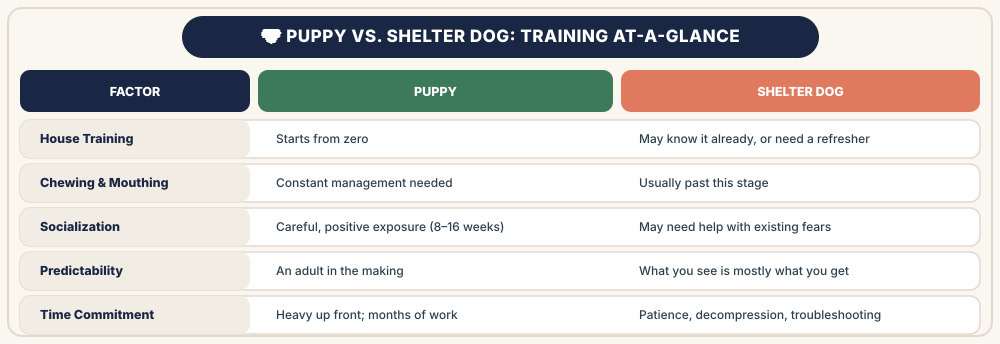
🍼 Raising a Puppy: The “Blank Slate” with a Massive To-Do List
The primary appeal of a puppy is moldability. A puppy arrives without previous baggage or unknown trauma. You get to introduce them to the sights, sounds, and smells of Los Angeles—from the ocean breeze in Santa Monica to the cafe patios of Culver City—right during their critical developmental socialization window (roughly 8 to 16 weeks).
Puppies are behavioral sponges. They learn hand targets, sit-stays, and crate games at lightning speed.
The Hidden Workload
The flip side of the “blank slate” is that you have to write every single line of code yourself.
- Constant Physical Supervision: A young puppy cannot be left unsupervised for even 90 seconds without risking house-soiling or chewing on furniture.
- Sleep Deprivation: With underdeveloped bladders, puppies require overnight potty trips for weeks.
- The “Raptor” Phase: Needle puppy teeth, mouthing hands, and zooming across the living room require continuous patience and redirection.
- Adolescence Arrives: Around 6 to 9 months, puppies enter adolescence, frequently “forgetting” their cues and pushing household boundaries.
Raising a puppy is physically demanding, high-repetition, front-loaded labor.
🐕 Adopting an Adult Shelter Dog: What You See Is (Mostly) What You Get
When you visit shelters like the West LA Animal Shelter on Amanda Street, browse adoption centers like NKLA / Best Friends Pet Adoption Center, or connect with local rescues across West LA, an adult dog offers an immediate advantage: their adult personality and physical blueprint are already established.
You know their adult size, their coat type, their baseline energy, and how they react to people.
Many adult rescue dogs are already house-trained, have fully matured past destructive puppy chewing, and understand how to settle quietly on a living room rug while you take Zoom calls.
The Trade-Off: History & Decompression
The variable with shelter dogs is their past history. You may not know whether they were previously exposed to sirens, skateboards, or other dogs. Some need patient guidance to learn that hands mean petting (not punishment), while others need help shedding shelter-acquired barrier frustration.
Important distinction: An adult rescue isn’t “broken” or “damaged.” They simply require a patient handler who understands how to build trust through consistency and predictability.
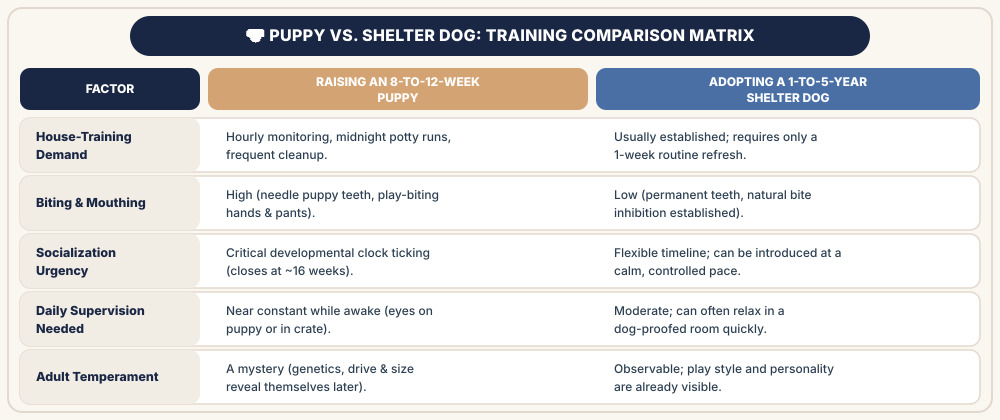
⚖️ Puppy vs. Shelter Dog: Training Comparison Matrix
Busting the Myth: “You Can’t Teach an Old Dog New Tricks”
Few myths in dog training are more inaccurate than this one!
Adult and senior dogs learn exceptionally well when trained with reward-based, force-free methods. In fact, adult dogs often learn faster than puppies because they have longer attention spans, higher impulse control, and the neurological capability to focus for 15 to 20 minutes without bouncing off the walls.
Age is never the obstacle in dog training—clarity, consistency, and motivation are what matter.
🧭 My Trainer Take: Which One Is Actually “Easier”?
When clients push me for an answer, here is my verdict:
- Puppies are physically harder. They demand broken sleep, endless floor management, constant eye contact, and physical cleanup.
- Shelter dogs require more emotional awareness. They need an owner who can read subtle body language, respect decompression timing, and troubleshoot specific past habits without taking things personally.
If you work long hours away from home or live in an apartment without a private yard, an adult shelter dog is almost always easier to integrate into your daily life. If you have a flexible schedule, work from home, and relish the active journey of shaping a dog from infancy, a puppy is an immensely joyful experience.
🛍️ Must-Have Gear: Puppies vs. Shelter Adoptions
Setting your home up for success requires tools tailored to your dog’s life stage:
For Puppies:
- 🍼 Heartbeat Comfort Toy: Ease first-week crate whining with the Original Snuggle Puppy Behavioral Toy.
- 🦷 Teething Chews: Save your baseboards and fingers with durable Nylabone Puppy Chew Teething Rings.
- 🏠 Adjustable Wire Crate with Divider: The MidWest iCrate Folding Metal Crate grows with your pup.
For Shelter Dogs:
- 🐕🦺 Escape-Proof Y-Harness: Prevent startled rescues from backing out of their collar with the Ruffwear Front Range Reflective Harness.
- 🧠 Lick Mats for Stress Decompression: Soothe nervous system stress with the Classic Slow Feeder Silicone Mat.
- 🦮 Fixed 6-Foot Training Leash: Keep handling calm and close with the Rubberized Non Slip Leash.
🎓 Setting Your New Addition Up for Success
Regardless of whether you bring home a bouncy puppy or an older shelter companion, professional guidance in the first month prevents small misunderstandings from becoming lifelong headaches.
- Jump-Start Manners: Our immersive Dog Boarding School Program provides daily professional handling to instill foundational obedience for newly adopted dogs or puppies.
- Neighborhood Realities: Work on leash manners, threshold manners, and crate comfort in your living room with customized private dog training.
- Distraction Mastery: Learn focus around other dogs in our structured group dog training classes.
- Workday Balance: Give your pup safe daytime socialization, manners practice, and rest rotations in our educational dog daycare.
At I Said Sit!, we have been helping Los Angeles pet parents raise polite puppies and help rescue dogs flourish since 1988.
Let’s discuss your home, your schedule, and your lifestyle to set your newest family member up for a lifetime of success.
👉 Book your free 15-minute Discovery Call today or give our West LA training team a call directly at 📞 (310) 558-9037!