Disclaimer: As an Amazon Associate, we earn a small commission from qualifying purchases made through the affiliate links in this post at no extra cost to you.
You have been turning it over in your mind for months. Your current dog is well-settled, your living space has room to spare, and bringing home a second pup sounds like double the joy, companionship, and trail-walking fun.
Yet in the back of your mind, you’ve heard the  multi-dog horror stories: sudden territorial growls, intense guarding over chew toys, a resident dog who suddenly retreats into hiding, or a peaceful living room transformed into referee central.
Introducing a second dog to your home can be an incredible, bond-deepening experience. But real success rarely happens by chance or by simply dropping two dogs into a living room together to “work it out.” It requires a deliberate, step-by-step roadmap.
Having spent 16 years coaching multi-dog families on our training floor at I Said Sit! (serving West LA, Culver City, Santa Monica, Venice, and Mar Vista since 1988), here is our proven framework for setting up a peaceful multi-dog household.
🧐 Step 1: Make Sure Your First Dog Is Genuinely Ready
Before looking at shelter adoption listings or breeders, take a completely honest look at your current dog.
Ask yourself:
- Does my dog genuinely enjoy canine company, or do they simply tolerate other dogs?
- Do they guard food bowls, chew bones, high-value sleeping spots, or your lap?
- Are their basic manners (leash walking, impulse control, recall) reliable?
⚠️ The Biggest Myth in Multi-Dog Homes
A second dog will never fix a bored, reactive, or anxious resident dog. In fact, adding a second dog almost always doubles the workload. Dogs are keen observational learners: your new dog will quickly adopt your resident dog’s bad habits—from fence barking to counter surfing—long before they pick up their good manners.
If your first dog struggles with resource guarding, anxiety, or on-leash reactivity, address those challenges first. Our customized private dog training lessons provide the foundational reset your first dog needs before introducing a newcomer.
⚖️ Step 2: Choose the Right Match (My Golden Rules of Compatibility)
When adding a second dog, opposites don’t always attract, but exact clones can compete. Over the years, I’ve developed three practical rules of thumb for pairing dogs:
- Energy and Play Style Matter More Than Breed: If you have an 11-year-old arthritic dog who enjoys quiet snoozing, bringing home an 8-week-old hyperactive puppy won’t “reinvigorate” your senior—it will exhaust and stress them out. Pair calm with calm, and high-drive play styles with dogs that match that intensity.
- Opposite Sexes Are Often Smoother: While two males or two females can certainly become best friends, male-female pairings statistically tend to experience fewer serious dominance or territorial squabbles. Female-female pairings, in particular, require very thoughtful matching and early supervision.
- Use Foster-to-Adopt Windows: Whenever adopting from a rescue or shelter, utilize a foster-to-adopt trial period whenever possible. It gives you a real-world look at how both dogs interact inside your actual living environment.
🚶 Step 3: Meet on Neutral Ground (The Parallel Walk)
Never, under any circumstances, introduce a new dog inside your front hallway, living room, or fenced backyard. To your resident dog, those spaces represent core territory.
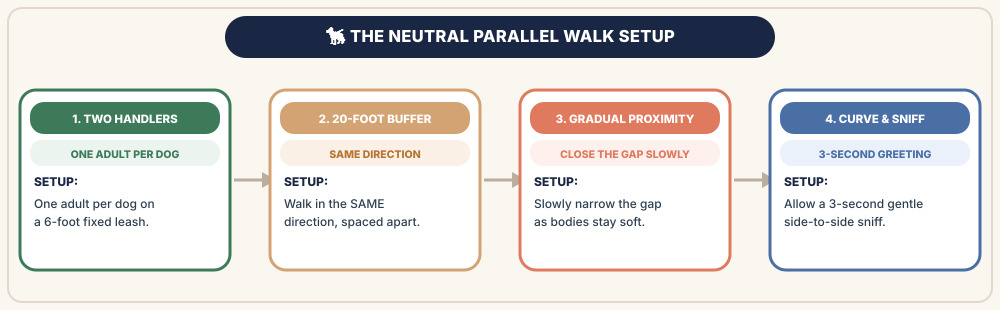
Instead, meet on neutral ground—a quiet neighborhood street, a wide park perimeter, or an open area where neither dog has established ownership.
- Walk in Parallel: Have two handlers walk the dogs in the same direction, separated by 15 to 20 feet. Walking parallel gives them a shared forward mission, lowering social pressure.
- Watch Body Language: Look for loose, wiggly spines, soft eyes, and natural sniffing. If you see stiff postures, “hard staring,” lip-licking, or freezing, open the distance back up immediately.
- The 3-Second Rule: Once both dogs are relaxed, allow a brief, 3-second side-by-side or nose-to-tail sniff, then cheerfully call them away (“Let’s go!”) and reward them. Keep initial greetings short, sweet, and successful!
Did you know? We frequently oversee neutral introductions as part of our private training programs. Having an expert eye on-site removes the anxiety and ensures both dogs feel completely supported.
🏡 Step 4: Prep Your Home Before Day One
Before bringing the new dog across your threshold, eliminate common conflict triggers:
- Sweep the House for “High-Value” Triggers: Pick up all marrow bones, bully sticks, favorite plush toys, and tennis balls. Resource guarding is the #1 trigger for early fights between unfamiliar dogs.
- Duplicate Core Resources: Ensure you have two separate water bowls, two distinct sleeping beds, and separate crates placed in distinct areas.
- Install Baby Gates: Pressure-mounted walk-through gates allow dogs to see and smell each other safely without feeling crowded.
- Create a Resident Dog “Sanctuary”: Make sure your first dog has access to a safe room where the new dog is never permitted to enter.
🚪 Step 5: The Calm Arrival
When arriving home, walk both dogs around the block together one last time to drain excitement.
Walk through the front door calmly. Let your resident dog enter the house first. Keep lightweight leashes or drag-lines attached to both dogs for their first few indoor interactions. Keep your own energy low, neutral, and relaxed. Allow them to explore the common area, and after 5 to 10 minutes of calm sniffing, separate them into their respective zones for a quiet decompression rest.
🛡️ Step 6: The 2-to-4 Week Active Management Window
This is where the vast majority of dog owners slip up.
During the first 3 to 5 days, a new rescue dog is often on their “best behavior” due to temporary stress shutdown. Owners let their guard down, thinking, “They love each other, we don’t need gates!” Then, around week two or three, the newcomer decompresses, true personalities emerge, and friction sparks.
Understanding the adjustment process is key to a smooth transition. To help visualize this adjustment timeline, review our Rule of 3s Infographic, which outlines what to expect during the first 3 days, 3 weeks, and 3 months.
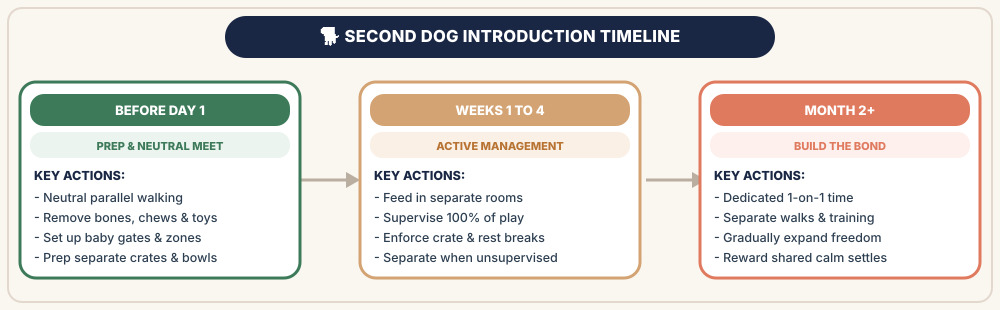
Commit to strict management for a minimum of 2 to 4 weeks:
- Feed Separately, Always: Feed in completely separate rooms behind closed doors or gates. Never feed dogs side-by-side during the first month.
- Proactive Play Breaks: Puppies and young dogs frequently miss social cut-off cues. Step in every 2 to 3 minutes during play, call both dogs over for a treat, let their heart rates settle, and then allow them to resume play.
- Separate When Unsupervised: Whenever you leave the house or cannot actively monitor the room, separate the dogs into their crates or gated areas.
- No High-Value Chews Together: Long-lasting bones or filled KONGs should only be enjoyed inside separate crates.
🛍️ Essential Multi-Dog Management Tools
Equipping your home with the right management tools keeps stress levels low and prevents conflicts:
- Pressure-Mounted Walk-Through Gate: Create distinct safe zones and visual boundaries with the Tall Walk-Through Pet Gate.
- Puzzle Feeders for Separate Meals: Turn mealtime into calm mental enrichment in separate rooms using the Outward Hound Fun Feeder Slo Bowl.
- Extra Dog Bed: It is important to be sure everyone can have their own space with a second bed like this Orthopedic Dog Bed.
🚶 Step 7: Give Each Dog Dedicated One-on-One Time
Your resident dog should never feel that the arrival of the newcomer means the end of their special bond with you. At the same time, your new dog needs individual connection to bond with you, not just with the other dog.
- Separate Neighborhood Walks: Walk each dog individually to start with. Even a professional doesn’t try to teach loose leash walking with two dogs at a time. This allows the newcomer to build confidence and learn how to walk nice.
- Individual Training Sessions: Practice basic cues for 5 minutes one-on-one. Enrolling your newcomer in our group dog training classes gives them focused handling practice around other dogs.
- Structured Daytime Support: If balancing two dogs alongside a busy West LA work schedule feels overwhelming, our educational dog daycare program or immersive boarding school program provides structured training, exercise, and manners practice while you settle into your new routine.
🚩 Green Lights vs. Red Flags
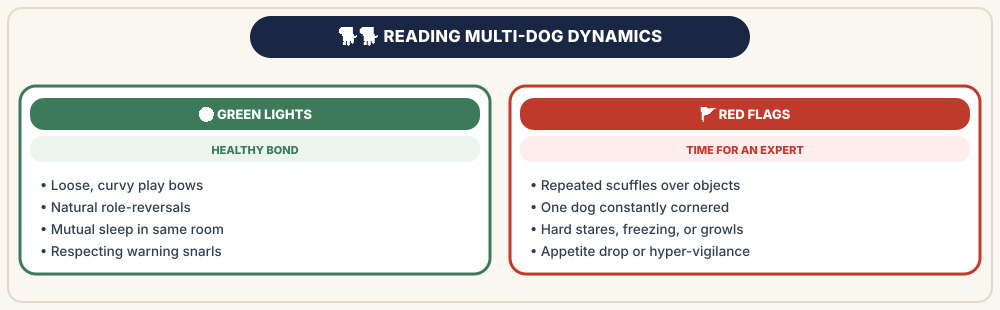
If you observe any red flag behaviors, do not wait for a bite to occur. Early behavioral intervention can completely salvage a relationship before negative patterns become hardwired habits.
🗓️ Ready to Build a Harmonious Multi-Dog Home?
Adding a second dog should enrich your family’s life, not bring stress, fear, or constant refereeing. With thoughtful matching, structured neutral introductions, and consistent management, your dogs can build a partnership that lasts a lifetime.
At I Said Sit!, we have been helping Los Angeles dog owners build peaceful, multi-dog households since 1988.
Whether you need pre-adoption compatibility advice, an expert to oversee your dogs’ first meeting, or personalized private dog training, our team is here for you.
👉 Book your free 15-minute Discovery Call today or give our West LA facility a call directly at 📞 (310) 558-9037 to set your dogs up for success!